The sandwich has been a presence in human eating for as long as bread has been made into slices and something worth eating has existed to place between them. It predates refrigeration, delivery apps, and the modern city — and yet it has never been more relevant, more suited to its moment, or more universally beloved than it is today, in the context of urban life in a city like Chicago.
There's something worth investigating in that observation. Why does the sandwich — essentially one of the simplest constructions in all of food culture — continue to dominate urban lunch preferences across generations, economic shifts, culinary trends, and the wholesale transformation of how and where people work? The answer turns out to be surprisingly rich, and it speaks to something fundamental about what makes food work well in a city.
The Architecture of Convenience
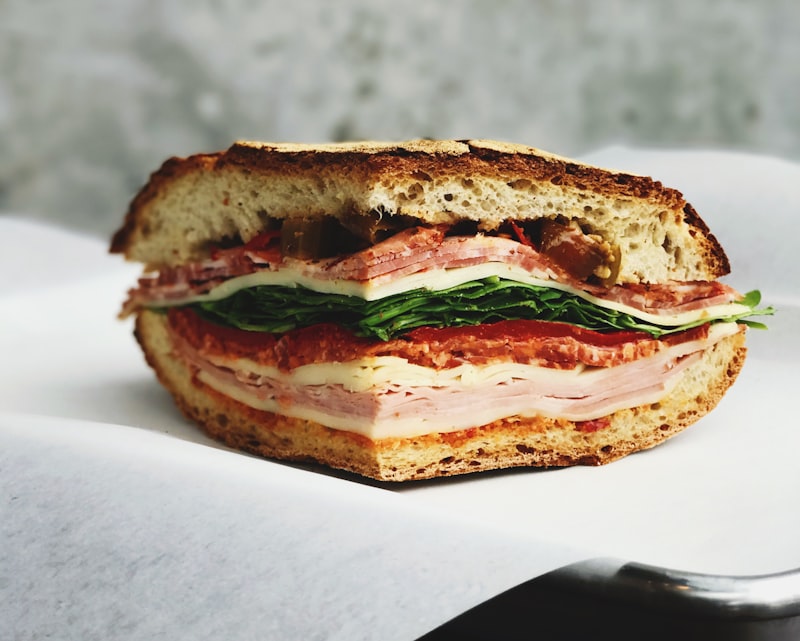
The starting point for understanding sandwich convenience is structural. A sandwich is, at its most fundamental, a self-contained food delivery mechanism. The bread serves not only as a flavor and textural element but as a vessel — one that holds its contents together, provides a handle for eating, and maintains its integrity across a range of temperatures and transit conditions that would cause other food formats to fail spectacularly.
Consider what happens to a bowl of pasta during delivery — the sauce separates, the pasta absorbs the liquid and becomes gummy, the temperature drops unevenly. Consider a carefully composed salad — the greens wilt under dressing, the croutons become soft, the components that were supposed to remain separate begin to merge in unpleasant ways. The sandwich, by contrast, is engineered to travel. Its components are held in place, its bread provides insulation against temperature loss, and the layering of ingredients protects each element from the others.
Eight Reasons Sandwiches Win the Urban Convenience Test
Inherent Portability
A sandwich requires no utensils, no plate, and no particular environment to eat successfully. It can be consumed at a desk, on a park bench, in transit, or standing at a kitchen counter without any loss of enjoyment.
Delivery Resilience
Unlike soups, pastas, or composed salads, a well-built sandwich maintains its structural integrity and flavor quality across the typical 15–30 minute delivery window. What arrives is essentially what was built.
Infinite Variety
The combination space of breads, proteins, cheeses, vegetables, and condiments is effectively unlimited. The same "format" yields wildly different experiences — from a delicate smoked salmon build to a hearty pastrami stack.
Dietary Adaptability
Every major dietary approach — vegetarian, high-protein, low-carb, dairy-free, gluten-aware — has a genuine sandwich tradition. No other single food format accommodates such a wide range of preferences so naturally.
Portion Intuitiveness
A sandwich is a natural portion — one unit of food that is neither too much nor too little by default. Unlike dishes that require serving, a sandwich is its own serving, which simplifies the entire eating experience.
Quick Ordering
The mental model for ordering a sandwich is simple and fast — bread, protein, additions. This simplicity means decisions are made quickly, orders are placed accurately, and customization is straightforward.
Cultural Universality
Every culture has its own sandwich tradition — the Vietnamese bánh mì, the Cuban sandwich, the Italian sub, the Middle Eastern pita, the Jewish deli stack. This means sandwiches carry cultural richness alongside their convenience.
Price Accessibility
Quality sandwich delivery spans a wide price range — from approachable everyday options to more elevated artisan builds — making it accessible across different budgets and occasions without a significant quality cliff.
The Sandwich in Chicago's Urban Context
Chicago brings its own particular dimensions to the universal story of sandwich convenience. The city has one of the most culturally layered food landscapes in North America — a living record of the immigrant communities that built it, the industries that shaped it, and the culinary creativity that continues to evolve within it. And within that landscape, the sandwich has always occupied a central, beloved position.
The Italian beef sandwich — thinly shaved beef in seasoned au jus, stuffed into a French roll with giardiniera or sweet peppers — is a Chicago original that speaks directly to the city's working-class Italian-American heritage and the practical demands of a city where lunch had to be fast, filling, and affordable. The deli culture of the North Side and the West Rogers Park neighborhood reflects Chicago's Jewish community. The influence of Polish, Greek, Mexican, and countless other culinary traditions appears throughout the city's sandwich landscape in ways both obvious and beautifully subtle.
When you order a sandwich for delivery in Chicago today, you are participating in a food tradition that is simultaneously ancient and utterly contemporary, deeply local and broadly universal. That combination is rare and genuinely worth appreciating.
Convenience That Doesn't Compromise Quality
One of the most compelling aspects of the modern sandwich delivery experience — particularly in a city as food-serious as Chicago — is the degree to which convenience and quality coexist without tension. This was not always the case in other food delivery categories. Early pizza delivery, for instance, involved a meaningful quality trade-off compared to eating at the restaurant. Early sushi delivery raised legitimate freshness concerns. But the sandwich, almost uniquely among delivery food categories, delivers at close to its full quality potential even during transit.
This is partly structural, as discussed earlier. But it also reflects the growing sophistication of Chicago's sandwich shops in how they prepare delivery orders — using bread that travels particularly well, sequencing the construction to protect delicate ingredients, and packaging that maintains temperature and structural integrity. The gap between "restaurant sandwich" and "delivered sandwich" at the best Chicago spots is genuinely narrow — sometimes imperceptible.
For the urban resident who values both quality and convenience — who refuses to accept that getting food delivered means accepting a degraded version of what the restaurant actually offers — the sandwich is the most reliable answer available. Explore our range of Everyday Sandwich Options, Healthy Choices, and Filling Meals to see the full breadth of what Chicago's delivery sandwich culture offers.
The Sandwich as a Daily Lifestyle Anchor
Beyond all the practical arguments for sandwich convenience — the portability, the delivery resilience, the variety, the quality — there is a more personal dimension worth acknowledging. The sandwich that you return to consistently, the one that has become a trusted part of your weekly lunch rotation, functions as a kind of lifestyle anchor. It's a small point of reliability in days that are often unpredictable, a familiar pleasure that you can count on when the larger picture of the day is uncertain.
This is not a trivial thing. Urban life generates a continuous stream of novelty, demands, and uncertainty that can be genuinely wearing over time. The small, reliable pleasures — the morning coffee ritual, the evening walk route, the lunch sandwich that always delivers — are not luxuries in this context. They are part of the infrastructure of a sustainable, enjoyable daily life.
Sandwich delivery, at its best, offers exactly this kind of reliable pleasure. It is convenient in all the practical ways we've explored — structurally, logistically, economically. But it is also, in its own modest way, a meaningful part of how many urban Chicagoans experience comfort, satisfaction, and a sense of their own preferences and identity expressed through the small, daily choice of what to have for lunch. That is why the sandwich endures. That is why it will continue to endure. And that is why a platform dedicated to understanding and celebrating the sandwich delivery lifestyle in Chicago is, we believe, genuinely worth your time.